JavaScript refactoring best practices.

I am a passionate and versatile Full Stack Web Developer and Technical Writer with a love for crafting innovative digital solutions and communicating complex technical concepts in a clear and engaging manner. As a technical writer, My writing style emphasizes clarity, consistency, and user-centricity, making it easier for developers and stakeholders to understand and adopt the technology.
1. Removing Code Duplication
Code duplication is a prevalent issue that can lead to maintenance difficulties and increased bug risk. Let's consider an example where the same logic is repeated in multiple places:

In the above code, the constant PI is duplicated in both functions. To refactor it, we can extract the duplicated logic into a separate function:

By utilizing the built-in Math.PI constant, we eliminate code duplication and improve code clarity.
2. Simplifying Conditional Logic
Complex conditional statements can make code harder to read and maintain. Let's consider an example with nested if statements:

To simplify the conditional logic, we can use a switch statement:

By using a switch statement, we make the code more concise and easier to understand.
3. Extracting Reusable Functions
Extracting reusable functions from existing code can enhance code organization and promote code reuse. Let's consider an example where similar code is repeated within different functions:
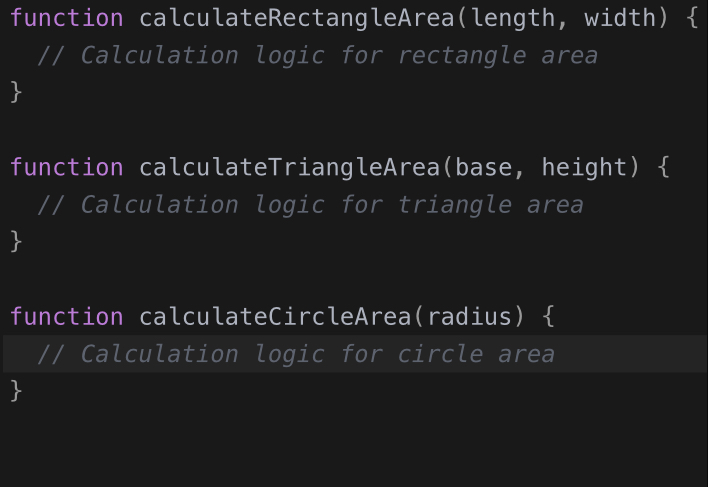
To avoid duplication, we can extract the common calculation logic into a separate function:

By extracting the common calculation logic into the calculateArea function, we improve code reuse and maintainability.
4. Use descriptive naming
By using descriptive naming, you make your code more understandable.
An example is the following code:

Using decimal as a constant name brings about confusion.

By changing the naming in the code above to a more descriptive one enhances readability.
5. Use camel casing
Camel casing means that every naming starts with a lowercase word and every subsequent word’s first letter will be capitalized.

The above code is read as the rapist finder instead of therapist finder.
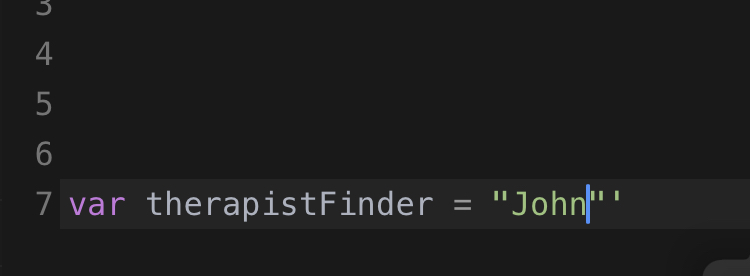
Camel casing aids easy identification of variables, function and types.